
Finite difference methods for a continuous-time heterogeneous agent model with recursive utility

by Yves Achdou & Qing Tang

Comment les préférences de long terme des ménages influencent-elles l’accumulation de richesse et l’équilibre macroéconomique ? Cet article apporte une réponse en étudiant un modèle d’agents hétérogènes de type Aiyagari dans lequel les ménages sont dotés d’une utilité récursive d’Epstein-Zin, permettant de distinguer l’aversion au risque de la préférence pour la substitution intertemporelle. Si cette spécification est devenue centrale en économie financière, elle pose des difficultés mathématiques considérables qui limitaient jusqu’à présent son intégration dans les modèles à agents hétérogènes. Continue reading

Posted in Working Papers | Leave a comment

Continuous-Time Heterogeneous Agent Models
with Recursive Utility and Preference for Late Resolution

by Yves Achdou & Qing Tang

Les modèles à agents hétérogènes sont devenus un outil incontournable de la macroéconomie moderne pour analyser les inégalités, l’épargne et les effets des politiques économiques. Dans cet article, Yves Achdou et Qing Tang franchissent une étape importante en intégrant les préférences récursives d’Epstein-Zin à ces modèles en temps continu, dans un cadre de jeux à champ moyen (mean field games). Cette approche permet de dissocier l’aversion au risque de la substitution intertemporelle et de prendre en compte la préférence des agents pour une résolution tardive de l’incertitude, une caractéristique essentielle de nombreuses décisions économiques. Continue reading

Posted in Working Papers | Leave a comment

Workshop « Mean field games and mean field control in economics »

16-17 décembre 2025 à l’Institut Henri Poincaré à Paris

We are now twenty years after the formulation of a general mathematical theory of mean field games, which induced itslef a growing interest in mean field control from mathematicians. Most of the recent mathematical developments have been quite independent from economics concern, and vice versa. Quite far from sounding pessimistic, this conference aims at bringing together the two communities, to revive and start the natural interactions between them.

Further information : https://www.ceremade.dauphine.fr/fr/actualites/mean-field-games-and-mean-field-control-in-economics.html

Posted in Conferences | Leave a comment

The MATS Summer School on Agricultural Finance

June 30 – July 4 2025, Centre Paul Langevin, Aussois

The aim of the summer school is to contribute to the development of research on the economic and financial implications of agricultural transitions, through the training of young researchers, with a dual focus on:

  • raising awareness and understanding of these issues
  • training in quantitative methods adapted to these issues

Particular emphasis will be placed on:

  • methods that make use of massive or high-dimensional data
  • risk management of agricultural transitions issues
  • connection with energy issues (through markets, through managing land and water use conflicts)

Further information on the Summer school website

Posted in Conferences | Leave a comment

NYU-Princeton Workshop on Future Electricity Grids and Energy Markets with Decarbonization

22-23 January 2025 at NYU Tandon, New York
The event aims to bring together academics and practitioners from France and the US to discuss current and future electricity production as power grids transition toward predominantly renewable and nuclear energy sources for decarbonization purposes. As countries attempt to move towards an net-zero carbon emissions electric grid, new challenges arise Continue reading

Posted in Conferences | Leave a comment

MATS Intern Seminar – July 18th, 2024

Venue :
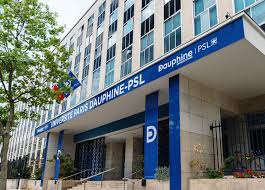
Université Paris Dauphine – PSL
Place du Maréchal de Lattre de Tassigny
Paris 16e 

Program
Continue reading

Posted in Conferences | Leave a comment

MATS Seminar Spring 2024

MATS Seminar // 15 May 2024 // Collège de France

The MATS Seminar was held at Collège de France (11 place Marcelin Berthelot, Paris) on May 15, 2024. Continue reading

Posted in Conferences | Leave a comment

The Fime Lab Summer School on Big Data & Finance

12-16 Jun 2023, Centre Paul Langevin, Aussois

The aim of the Summer school is to review some aspects of quantitative methods applied to economics and finance. Particular emphasis will be placed on methods that make use of massive or high-dimensional data and on applications to energy issues, in line with the research themes of the FiME laboratory. Three themes will be highlighted, all of which are particularly relevant to today’s world and pose crucial challenges: “High Dimensional Econometrics”, “Differential Privacy”, “Market Microstructure”.

Further information on the Summer school website

Posted in Conferences | Leave a comment

Renouvellements de la Chaire FDD et du laboratoire FiME

Nous avons le plaisir d’annoncer le renouvellement de la Chaire FDD et de l’Initiative de Recherche « Laboratoire FiME », à partir du 1er janvier 2022 et pour 5 années supplémentaires. Ce renouvellement a été rendu possible par le soutien et l’engagement exceptionnels des partenaires qui accompagnent ces projets depuis leurs débuts en 2006 : les mécènes, EDF R&D et le Crédit Agricole – CIB ; les partenaires académiques, l’Université Paris-Dauphine et l’École Polytechnique ; la Fondation Institut Europlace de Finance et l’Institut Louis Bachelier qui hébergent ces deux projets sur les plans juridique, administratif et organisationnel.

Continue reading

Posted in Non classé | Leave a comment

Applications of Mean Field Games From Models to Practice

November 16-19, 2021, IMSI, Chicago

The paradigm of Mean Field Games (MFG) has become a major connection between distributed decision-making and stochastic modeling. Starting out in the stochastic control literature, it is gaining rapid adoption across a range of industries. The objective of this workshop is to give a clear vision of how MFG tools are being used in practical settings, both in complement and in contrast to the usual methodologies. The workshop will gather researchers both from industry and universities and will focus on diverse application areas, including Continue reading

Posted in Conferences | Leave a comment

Journées-ateliers du Laboratoire FiME

22-23 septembre, 2021, EDF Lab, Palaiseau

Des « Journées-ateliers » du laboratoire FiME ont eu lieu les 22 et 23 septembre dans les locaux d’EDF à Palaiseau et ont réuni environ 70 personnes sur deux jours. Continue reading

Posted in Conferences | Leave a comment

Summer school on Distributed Control: Decentralization and Incentives

June 14-18, 2021, CIRM (Luminy, France)

We are living in an era of technology explosion. While resources, products and information become increasingly accessible to common users, the individuals nowadays are more aware than ever of their own right, and more capable than ever of deciding for their own good. This trend forces the old organization governing the social welfare to adapt. Eventually we ask how to balance the individual fairness and the global goodness. The social planners would have no choice but decentralize their power of managing globally, and leave the decisions to individuals. Meanwhile, they still keep the resource and have the duty to offer the individuals the right incentives in order to keep the society on the right track.

Continue reading

Posted in Conferences | Leave a comment

The Role of Financial Investors in Commodity Futures Risk Premium

by Mohammad Isleimeyyeh

I develop and test a theoretical model to study the interaction between the commodity and stock markets. The article attempts to clarify the debate between the two conflicting empirical opinions about the effect of the financialization on commodity markets: one that claims there is an effect, and one that denies that effect. The theoretical model determines the futures risk premium by using three factors: the hedging pressure, the stock market returns, and the commodity-equity correlation. I test the futures risk premium in the era of the financialization for three commodities in the energy market: crude oil (WTI), natural gas, and heating oil in Continue reading

Posted in Working Papers | Leave a comment

Sur la méthode de l’économie

by Pierre-Noël Giraud

Cet article propose de reprendre certains aspects du débat épistémologique et méthodologique sur l’économie à la lumière d’une description pragmatique, inspirée de la sociologie des sciences, de la manière dont « ça fonctionne » et plus précisément de : i) la façon dont l’économie s’insère dans le débat politique et manifeste ainsi son caractère « performatif » et ii) sa méthode d’élaboration de modèles et de théories. Cette double description permet à l’auteur quelques remarques et hypothèses sur : l’unité et la diversité des discours économiques, la pertinence de la distinction entre écoles et entre grandes théories générales, la différence entre modèles et théories, l’impérialisme de l’économie, l’apport des mathématiques, le débat Continue reading

Posted in Working Papers | Leave a comment

Évolution de l’emploi nomade et sédentaire dans une politique de transition énergétique : l’exemple du scénario négaWatt

by Philippe Frocrain, Charles Gallais & Pierre-Noël Giraud

Nous utilisons une méthode entrée-sortie pour évaluer l’effet sur l’emploi du scenario negaWatt, en nous fondant sur les plus récentes évaluations par Quirion (2017) du choc de demande qu’il engendre. Nous mesurons, dans les emplois créés et perdus, la part d’emplois nomades et sédentaires, telle que calculée pour la France par Frocrain Giraud (2018). Les résultats montrent qu’une croissance verte telle que décrite par négaWatt contribuerait à relocaliser le système productif, mais qu’une demande forte d’emplois Continue reading

Posted in Working Papers | Leave a comment

Le ratio réserves prouvées / production annuelle des commodités minérales : Faits stylisés et micro-fondation

by Pierre-Noël GIRAUD, Pierre FLECKINGER & Yosri SAKLY

La crainte d’une pénurie de matières premières minérales, qui sont issues de ressources naturelles dites « épuisables », ressurgit périodiquement. L’indicateur de rareté généralement utilisé est le ratio : Réserves prouvées mesurées par le USGS / production mondiale annuelle, Le ratio R/P. On craint aujourd’hui une pénurie des métaux qui seront fortement demandées par la transition écologique et énergétique en cours : le cuivre, le cobalt, les métaux des terres rares et du coltran. Pourtant le ratio R/P du cuivre, par exemple est resté remarquablement stable autour de 40 ans et ce depuis 1950, alors que la production a été multipliée par 8, et donc les réserves. Et ceci est Continue reading

Posted in Working Papers | Leave a comment

The joint dynamics of spot and futures commodity prices

by Ivar Ekeland, Edouard Jaeck, Delphine Lautier & Bertrand Villeneuve

We model the dynamic behavior of spot and futures commodity prices with an infinite horizon rational expectations equilibrium model. A new type of proof of existence of the equilibrium is provided. Using simulations with minimal changes between scenarios, we explore the specific effects of market structure, autocorrelation of production, and global risk aversion. The market structure can change a virtually nonstorable commodity into a high-inventory one. A high autocorrelation soften the apparent effects of storage in the short run. Global risk aversion typically decreases when financialization is developed. The effects on the joint price dynamics, risk sharing and physical choices are explored. Continue reading

Posted in Working Papers | Leave a comment

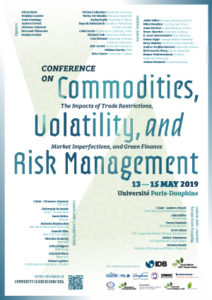
Conference on Commodities, Volatility, and Risk Management The Impacts of Trade Restrictions, Market Imperfections, and Green Finance

13-15 May 2019, Université Paris-Dauphine

The conference will cover commodity pricing and risk management, viewed through the prisms of market imperfections and environmental concerns. The main focus is on agricultural and energy markets, with specific themes intended to shine light on what the organizers and members of the scientific, industry, and policy advisory committees believe will be prominent issues in the near future.

For further information, call for papers, online submission and registration: https://commodity.sciencesconf.org/

Posted in Conferences | Leave a comment

Deep neural networks algorithms for stochastic control problems on finite horizon, part II: numerical applications

by Côme Huré, Huyên Pham, Achref Bachouch & Nicolas Langrené

This paper presents several numerical applications of deep learning-based algorithms that have been analyzed in [Bachouch et al., 2018a]. Numerical and comparative tests using TensorFlow illustrate the performance of our different algorithms, namely control learning by performance iteration (algorithms NNcontPI and ClassifPI), control learning by hybrid iteration (algorithms Hybrid-Now and Hybrid-LaterQ), on the 100-dimensional nonlinear PDEs examples from [Weinan et al. 2017] and on quadratic Backward Stochastic Differential equations as in [Chassagneux et al., 2016]. We also provide numerical results for an option hedging problem in finance, and energy storage problems arising in the valuation of gas storage and in microgrid management.

Download the paper

More working papers

Posted in Working Papers | Leave a comment

Deep neural networks algorithms for stochastic control problems on finite horizon, part I: convergence analysis


by Côme Huré, Huyên Pham, Achref Bachouch & Nicolas Langrené

This paper develops algorithms for high-dimensional stochastic control problems based on deep learning and dynamic programming (DP). Differently from the classical approximate DP approach, we first approximate the optimal policy by means of neural networks in the spirit of deep reinforcement learning, and then the value function by Monte Carlo regression. This is achieved in the DP recursion by performance or hybrid iteration, and regress now or later/quantization methods from numerical probabilities. We provide a theoretical justification of these algorithms. Consistency and rate of convergence for the control and value function estimates are analyzed and expressed in terms of the universal approximation error of the neural networks. Numerical results on various applications are presented in a companion paper [Bachouch et al., 2018b] and illustrate the performance of our algorithms.

Download the paper

More working papers

Posted in Working Papers | Leave a comment